Son hugging dad

Palliative Care

Palliative care is an approach to managing chronic disease and other serious and advanced illness that centers on relieving suffering and improving quality of life for patients and their families. Seven out of ten Americans who die each year die of a chronic disease. Our health care services need to evolve to provide appropriate care.

Palliative care customizes treatment to meet the needs of each individual, seeking to relieve pain, anxiety, shortness of breath, fatigue, nausea, loss of appetite, and other symptoms. Practitioners of palliative care help patients and their families understand treatment options, and facilitate effective communication among health care professionals, patients, and family members. Emotional and spiritual support for the patient and family are hallmarks of palliative care.

Palliative care differs from hospice in that it is appropriate at any point in a serious illness and can be provided at the same time as curative treatment. It may be offered in a variety of settings: hospitals, long-term care facilities, or people's homes. Aside from improving patient comfort and family satisfaction, studies have shown that hospital-based palliative care can have a positive economic impact.

To date, palliative care programs have developed primarily in large hospitals in urban settings. Models of palliative care for long-term care and for rural communities lag behind.

According to Minnesota's state demographer, by 2030, 21 percent of Minnesota's population will be over the age of 65, compared to 12 percent in 2000. This trend has enormous implications for health care services in rural areas, which already are burdened by fewer health care resources and a larger percent of elderly residents.

Palliative Care. This presentation defines the components and importance of palliative care, discusses approaches and interventions to help patients and families identify and communicate goals for care, especially in the home care setting, and discusses ways professional staff can support patients and families who are "not ready" for hospice. Presented by Shiri Etzioni, MD, Lyn Ceronsky, APRN, MS, and Virginia Bender, RN, BS of Transitions and Life Choices, University of Minnesota Medical Center, Fairview Health Services. (57-minute recorded Webinar)

Handout (42-page PowerPoint PDF)

Rural Palliative Care

Rural communities are uniquely positioned to meet the challenges of providing palliative care through collaborative efforts. Rural communities with similar areas of focus can benefit from structured opportunities to connect and share tools and lessons learned in implementation. A set process and timeline, access to palliative care program development expertise, and external facilitation to help initiate and develop community-based teams are important aspects that can assist in further developing community-based palliative care efforts in rural areas.

During a six-month pilot project, Stratis Health provided technical assistance, for planning and developing palliative care services, to three rural communities: Franklin, North Carolina; Ruleville, Mississippi; and Valley City, North Dakota. The project was conducted under contract with the National Rural Health Association, funded through the Health Resources and Services Administration, Office of Rural Health Policy. National Rural Health Association, Rural Palliative Care Pilot Project, Final Report, September 29, 2009 (40-page PDF)

Minnesota Rural Palliative Care Initiative

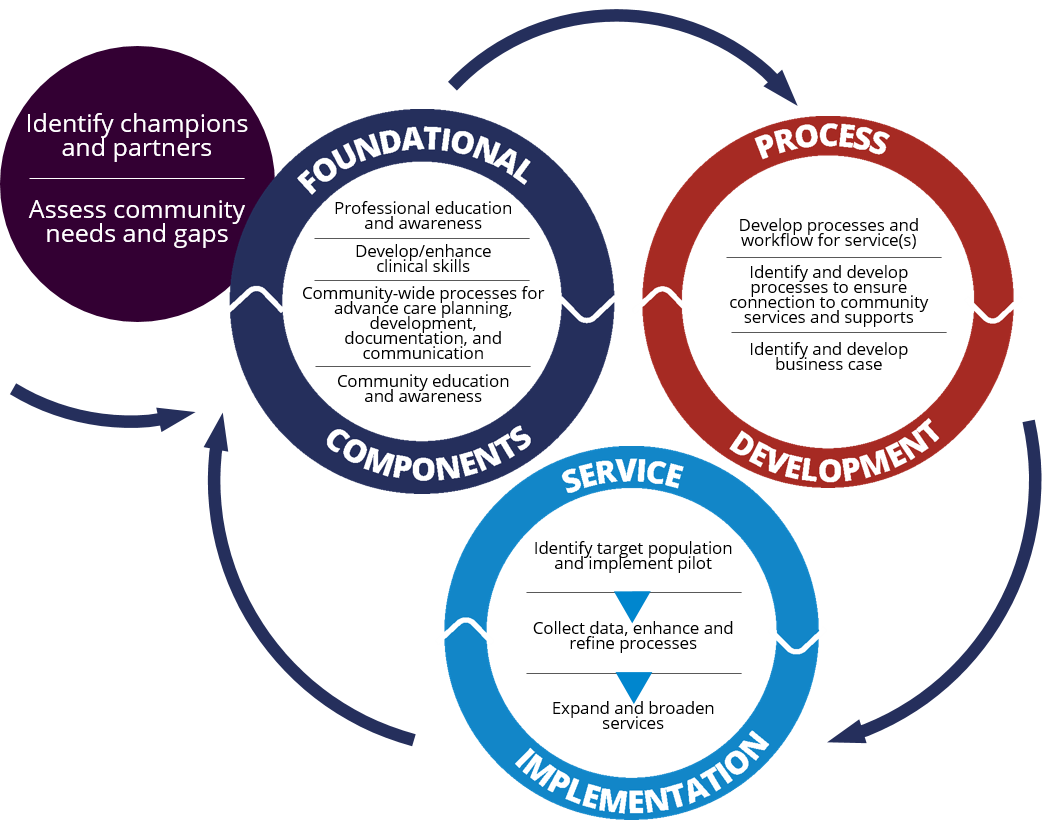
Stratis Health is leading the Minnesota Rural Palliative Care Initiative, bringing together 10 rural communities to start or strengthen palliative care programs in their communities. Beginning in fall of 2008, Stratis Health is facilitating a learning collaborative, through which the community teams will design a model or focus for their community and will receive education to improve skills in palliative care. Over the course of 18 months, Stratis Health will host three learning sessions on palliative care, including care models in rural communities and core competencies for palliative care. Between the learning sessions, communities will work to achieve goals and will receive technical support. The work will culminate with an outcomes congress, where key learnings and accomplishments will be shared.

Managing a serious illness "takes a village." Palliative care brings together the support systems that patients-along with their doctors and with their families-need to determine how to plan for the best quality of life. For this reason, the community teams participating in the Minnesota Rural Palliative Care Initiative are made up of a variety of professionals from doctors and nurses to bereavement coordinators and clergy. Up to seven different organizations are participating on each of the teams, representing various combinations of care settings, including:

  • Assisted living
  • Clinics
  • Home health
  • Hospice
  • Hospitals
  • Nursing homes
  • Parishes and parish nurses
  • Public health agencies
  • Universities


The teams represent communities of varying sizes from across the state, variety in the type of organization where the palliative care program will be based, and diversity of organizations leading the teams. The 10 participating communities and their lead organizations are:

  • Bemidji - Bemidji State University Department of Nursing
  • New Ulm - New Ulm Home Care and Hospice
  • Olivia - Renville County Hospital & Clinics
  • Red Wing - Fairview Red Wing Health Services
  • Roseau - LifeCare Home Medical Center
  • Staples - Lakewood Health System
  • Waconia - Ridgeview Medical Center
  • Wadena - Tri-County Community Health Services
  • Willmar - Rice Memorial Hospital
  • Winona - Winona Area Hospice

Full list of organizations in the participating communities

Of the 10 communities participating in the Minnesota Rural Palliative Care Imitative, only Red Wing and Staples currently have a palliative care program in their community. Each team will develop and implement an action plan for developing and/or enhancing a palliative care program in their community. These programs will help patients better manage their symptoms, improve satisfaction with the family-clinician relationships, decrease problems with transitions between health care providers-such as when patients move from hospitals to nursing homes or from nursing homes to receiving care at home from a home health agency.

Thirty-five communities applied to participate in the initiative, indicating a strong interest and need to develop palliative care services to support rural communities. If successful, Stratis Health's rural palliative care project will be a model for implementing palliative care programs in rural areas throughout Minnesota and the country.

Introductory Presentation. Provides an introduction to palliative care and the Minnesota Rural Palliative Care Initiative (audio file, 7/17/08). Handout (42-page PowerPoint PDF)

Stratis Health is leading the initiative, in partnership with Fairview Health Services' Palliative Care Program. UCare has provided funding for the initiative. The Minnesota Department of Health - Office of Rural Health and Primary Care is providing a stipend to each community to help off-set travel costs.

If you have questions about the Minnesota Rural Palliative Care Initiative, contact Janelle Shearer, Stratis Health program manager, at 952-853-8553.

Project description fact sheet (2-page PDF)

Palliative care resources

Contact Stratis Health for assistance with your quality improvement and patient safety needs.

If your organization has projects it would like to work on, contact us to discuss how we can work together to support initiatives related to palliative care.

Janelle Shearer, program manager
952-853-8553

Karla Weng, program manager
952-853-85570